
Must-Know Fertility Words for Every Stage of Your Journey, Part 4: Results, Monitoring, and What Comes Next
Must-Know Fertility Words for Every Stage of Your Journey, Part 4: Results, Monitoring, and What Comes Next
The new and different vocabulary of fertility care doesn't stop once a cycle ends. The terms in this blog are the ones that show up during results calls, early scans, and conversations about what to do next. They can be harder to absorb because they're attached to the news you've been working toward for months. Having seen them once before that appointment means they're one less thing to process when it counts.
This glossary covers three categories. First, the language of early pregnancy results and monitoring. Second, cycle outcomes. Third, planning your next step. It's the final installment of a four-part series. If you're just joining, the earlier parts are here:
Glossary of Fertility Terms: Results and Early Pregnancy Monitoring
The terms below come up in the days and weeks after a transfer or completed cycle.
Beta hCG Test
A beta hCG test is a blood test that measures human chorionic gonadotropin. Your body starts producing this hormone once an embryo attaches to the uterine lining. It signals your body to produce progesterone and other hormones that support the pregnancy in its earliest weeks. Clinics run this test about 10 to 14 days after embryo transfer to find out whether that process has started.
You'll first hear this term on your results call, and again during follow-up bloodwork. Care teams usually repeat the test after 48 hours to see whether the level is rising, falling, or holding steady.
Chemical Pregnancy
A chemical pregnancy is a pregnancy that ended very early, before it developed enough to be visible on an ultrasound. The word "chemical" refers to how the pregnancy was detected. The only proof it existed was the hCG in the bloodwork. There was never a gestational sac or heartbeat on a scan.
You'll hear this term during a follow-up results call when hCG levels drop after an initial positive. Cleveland Clinic offers more information for patients who want to read further.
Clinical Pregnancy
A clinical pregnancy is one that's progressed far enough to be confirmed through ultrasound. A gestational sac, a heartbeat, or both are visible on the scan. This is the point where the pregnancy moves beyond bloodwork confirmation.
You'll see this term in your chart notes after an early scan, typically around 6 to 8 weeks.
Implantation
Implantation is the process where an embryo attaches to the lining of the uterus. In treatment, this happens within a few days after transfer and triggers the body's production of hCG (see Beta hCG Test, above).
You'll hear this term when your team explains the testing timeline after transfer. It's the reason the beta test is timed the way it is.
Viability Scan
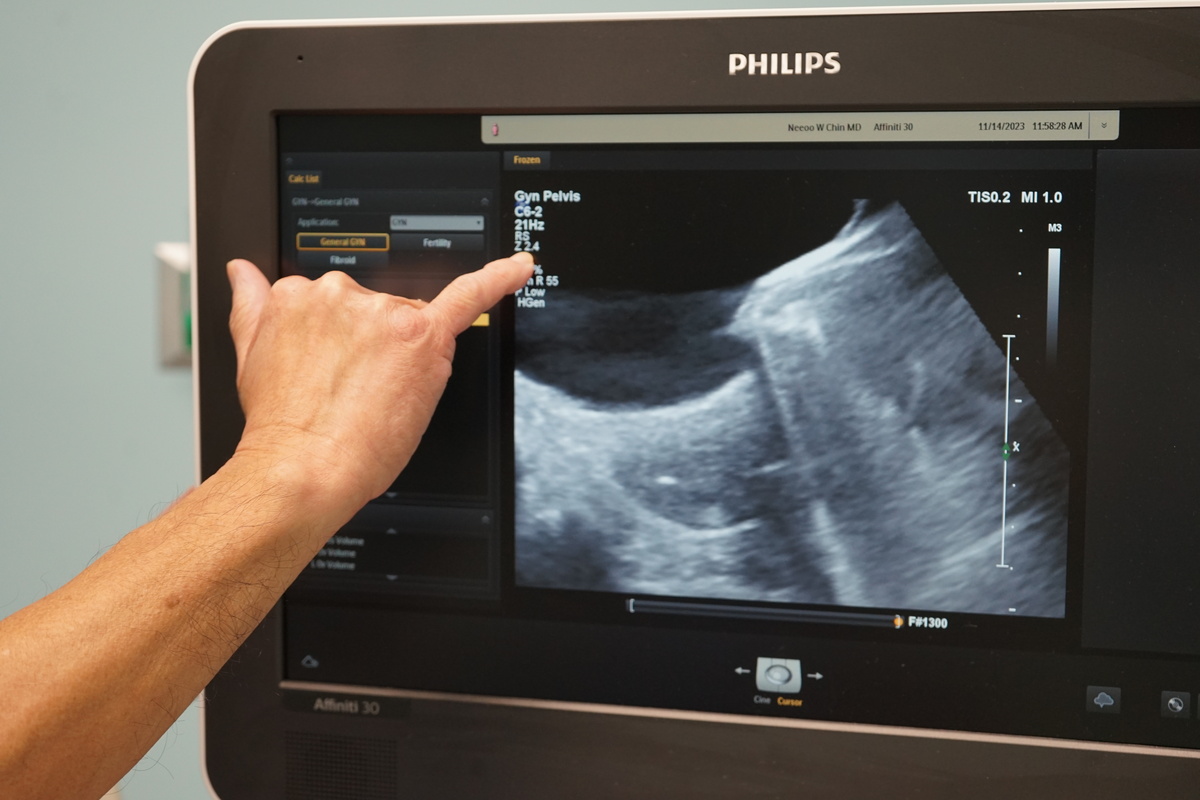
A viability scan is an early pregnancy ultrasound, typically performed around 6 to 8 weeks. It confirms three things: that the pregnancy is in the correct location (see Ectopic Pregnancy, below), that a heartbeat is present, and whether the pregnancy is a singleton or multiple.
You'll hear this term when your clinic schedules the scan that follows your initial results. It's often the first imaging appointment after a positive beta hCG test.
Ectopic Pregnancy
An ectopic pregnancy is a pregnancy where the embryo implants outside the uterus, most commonly in a fallopian tube. It's a serious situation that requires prompt evaluation and treatment.
You may hear this term during early monitoring if hCG levels aren't rising as expected. You may also hear it at the viability scan if the pregnancy isn't visible in the uterus. A positive pregnancy test does not rule out an ectopic pregnancy. Mayo Clinic Health System has more detail on signs and treatment.
Glossary of Fertility Terms: Cycle Outcomes and Support
These terms come up when discussing what happened during a cycle that didn't result in an ongoing pregnancy.
Luteal Phase Support
Luteal phase support is progesterone medication given after transfer or after ovulation in IUI cycles. It helps support the uterine lining during the window when implantation may occur. It can be given as vaginal suppositories, injections, or oral medication.
After transfer, you'll keep taking it while you wait for your beta hCG results. If the cycle is successful, support typically continues until around 10 weeks of pregnancy.
Failed Cycle
A failed cycle is one that was completed but did not result in a pregnancy or in an ongoing pregnancy. This is different from a canceled cycle, which is stopped before completion.
You'll hear this term in follow-up appointments where your care team reviews what happened. Those conversations often include a protocol adjustment. That means changes to medications, timing, or transfer strategy. The word "failed" is clinical language. It describes what happened with the cycle, not the people going through it or the effort behind it.
Canceled Cycle
A canceled cycle is one that's stopped before it's completed, usually before egg retrieval or transfer. A cycle might be canceled because too few follicles are developing. It can also happen if the ovaries respond too strongly to medication, raising the risk of ovarian hyperstimulation.
You'll hear this term during a monitoring appointment if the cycle isn't progressing as expected. In some cases, a canceled IVF cycle can be converted to an IUI cycle instead, which is called a conversion.
.png)
Glossary of Fertility Terms: Next Steps and Long-Term Planning
After a cycle ends, conversations turn to what comes next. These are the words you'll hear when planning future cycles, transfers, and storage.
Frozen Embryo Transfer (FET)
During IVF, multiple embryos are often created from a single egg retrieval. Not all of them are transferred at once. Some may be set aside for genetic testing. Others are saved so you have options for future cycles without starting the process over. When one of those frozen embryos is transferred later, that's a frozen embryo transfer, or FET.
You'll hear this term during planning conversations after a retrieval or a previous transfer. The team at FWIO can walk through which path fits your situation.
Embryo Banking
With embryo banking, patients create and freeze embryos across one or more cycles for future use. They aren't transferred right away. This approach helps build a larger embryo reserve before beginning transfers.
You'll hear about banking during long-range family planning conversations. Banked embryos are kept through cryopreservation and require a storage agreement. The agreement covers how long the embryos are stored and what decisions need to be made over time.
Cryopreservation
Cryopreservation is the controlled freezing of eggs, sperm, or embryos for future use. The technique, called vitrification, prevents ice crystal damage during the freezing process.
You'll hear this term in conversations about what happens to embryos after a retrieval cycle. It also comes up in any long-term planning involving storage.
Bring Your Fertility Questions to The Fertility Wellness Institute of Ohio
The terms in this blog cover some of the most high-stakes moments in fertility care. Our hope is that having them in one place takes some of the weight off those conversations. Your focus should be on yourself and the process, not on decoding what your care team is saying.
This four-part series is designed to be a resource you come back to. Bookmark the entries and revisit them before appointments. If you have questions about any of these terms, contact The Fertility Wellness Institute of Ohio to schedule a consultation. We can talk through your next step together.